A Story of Strings, Sound, and Renaissance Genius
Long before the violin became the elegant star of orchestras and concert halls, it began as a humble idea—one that emerged not in a flash of brilliance, but through slow, curious evolution. To trace the history of the first violin is to travel back to a time when music was shifting from medieval chants to something more lyrical, more emotional, more human.
A Time of Transformation: 16th-Century Northern Italy
The violin as we know it appeared in the early 1500s, in the northern regions of Italy—particularly in Brescia and Cremona. These towns were rich with artisans, woodworkers, and musical innovation. The instrument didn’t spring out of nowhere. It was born from centuries of bowed instruments that came before it.
There were the rebec, the lira da braccio, and the vielle—early stringed instruments used across Europe and the Middle East. They shared the idea of drawing a bow across strings to produce sound, but none had the form or voice of the modern violin.
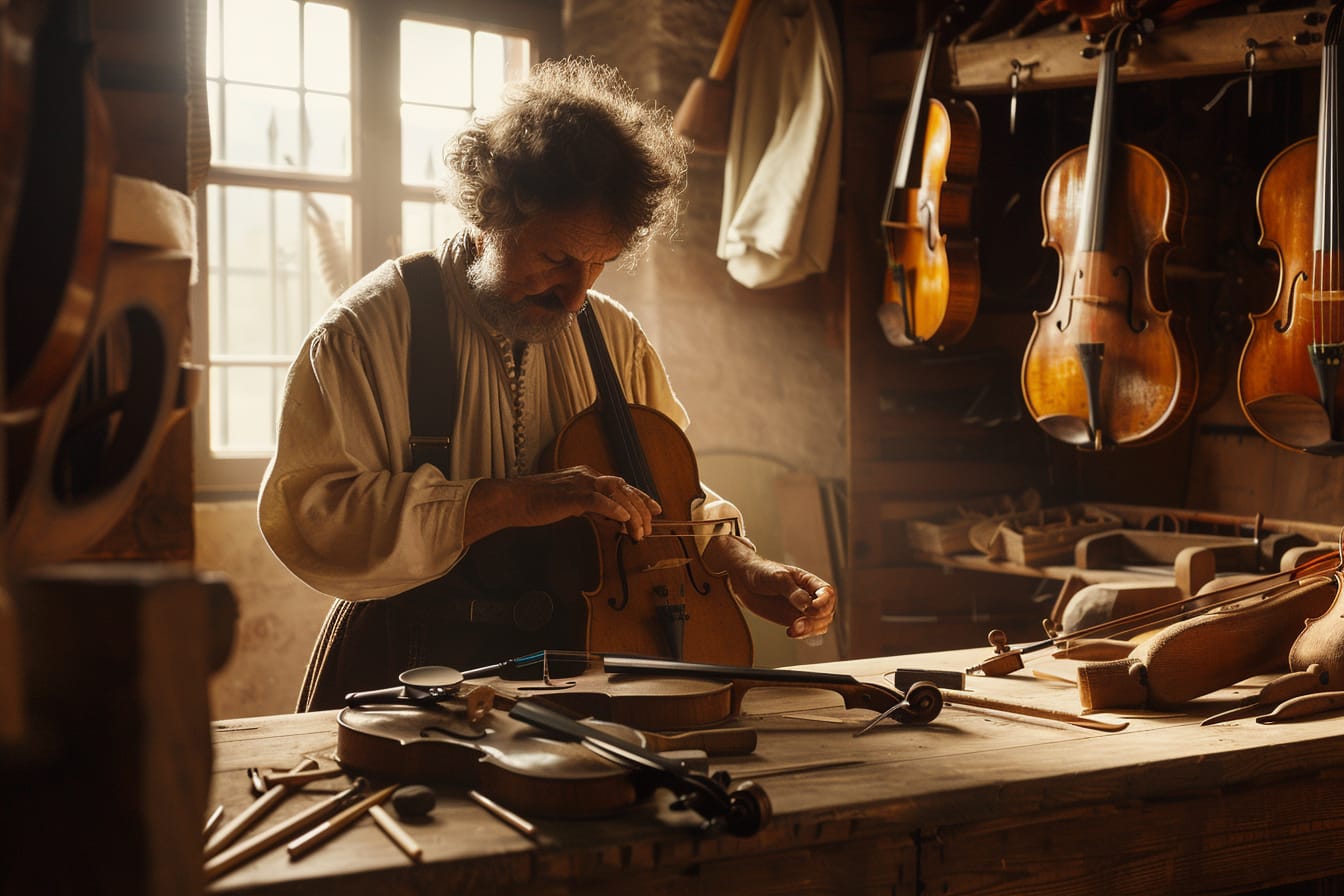
The turning point came when luthiers—musical instrument makers—began to combine the best elements of these early instruments. They shortened the body, curved the shape for resonance, and refined the strings and bridge to allow for dynamic range and expression.
Andrea Amati: The Father of the Violin
The first true violin, as we now understand it—with four strings tuned in fifths, a curved wooden body, and a rich, projecting tone—was likely crafted by Andrea Amati of Cremona around 1555–1560. He is widely considered the father of the violin.
Amati’s violins were more than instruments. They were works of art. Made from spruce, maple, and ebony, his violins were varnished with care, often decorated with royal crests and intricate details. His work caught the attention of Charles IX of France, who ordered 38 string instruments—including violins—for the French royal court.
Amazingly, a few of Amati’s original violins still survive today. One of the oldest, nicknamed the "Charles IX violin,"dates to 1564 and is preserved in museums and private collections.
How the Design Endured
What’s remarkable is how little the design has changed since Amati’s day. His student, Antonio Stradivari, would later refine the violin to a level that has never been surpassed. But the essence of the instrument—the way it cradles under the chin, the curve of the body, the tension of the strings—remains almost identical.
That speaks to the genius of the early luthiers. They weren’t just making instruments. They were defining the future of Western music.
Why It Mattered
Before the violin, much of Western music was vocal or played on keyboard and plucked strings. The violin introduced something new: a way to sing through wood, to express sadness, joy, anger, love—all with a bow and a breath of sound.
It became essential to chamber music, opera, and eventually the full symphony orchestra. The violin could play melody and harmony, whisper and shout, lead and blend. It became the heart of the ensemble.
A Legacy Still Heard Today
To this day, every student who picks up a violin continues this 500-year-old story. The same principles apply. The same structure, the same tuning. And in many ways, the same magic.
So the next time you hear a violin solo, or see a child learning to hold a bow for the first time, know that you’re hearing echoes of Renaissance Italy. You’re witnessing an unbroken chain of tradition that began in a dusty Cremonese workshop with wood, strings, and a dream.