A Story of Strings, Hammers, and Genius
Today, we think of the piano as a symbol of elegance and musical possibility. Its rich tones can echo through concert halls or whisper softly in a quiet living room. But the story of how the very first piano came into being is just as rich and resonant as the music it produces. It’s a tale that begins in 18th-century Italy, with one curious man who dared to ask: What if we could control sound, softly and loudly, with just our fingers?
Before the Piano: The Clavichord and the Harpsichord
Before the piano existed, there were two main keyboard instruments: the clavichord and the harpsichord. The harpsichord was majestic and ornate—perfect for Baroque music—but had a limitation: you couldn’t control how loudly or softly it played. Every note came out at the same volume, no matter how gently you pressed the keys.
The clavichord, on the other hand, allowed some expression of dynamics, but it was too quiet to be heard in a large room or concert setting. Musicians longed for something more responsive—an instrument that could sing or shout depending on the mood, something that felt alive beneath the hands.
Enter Bartolomeo Cristofori: The Inventor
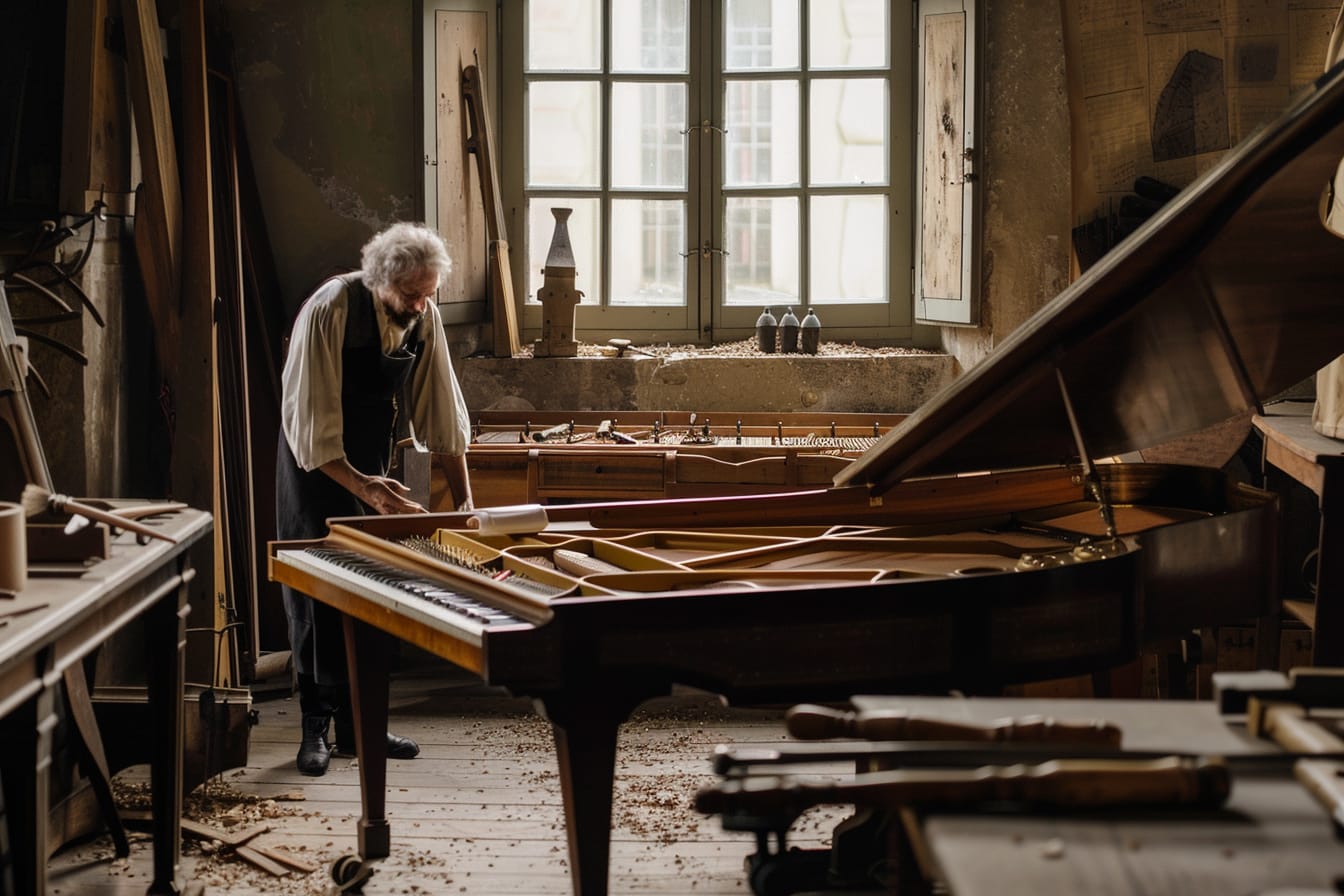
The man who changed everything was Bartolomeo Cristofori, an Italian instrument maker from Padua. He was hired by the powerful Medici family around 1688 to care for their collection of musical instruments in Florence.
Cristofori was a master harpsichord builder, but he was restless. Around 1700, he built the very first version of what he called the “gravicembalo col piano e forte”—which means “harpsichord with soft and loud.” Over time, this was shortened simply to “piano.”
What Made It Revolutionary?
Cristofori’s invention was revolutionary not because it made noise—it was how it made noise. He designed an ingenious hammer mechanism that struck the strings instead of plucking them (as in the harpsichord). These hammers allowed a pianist to control the volume based on how hard or soft they pressed a key.
This new system introduced an entirely new level of expressiveness. Musicians could now play with dynamics, emotion, and nuance, opening the door to more complex and lyrical music.
The Surviving Originals
Cristofori built around 20 pianos in his lifetime, but only three of them survive today:
- 1700 model – Located in the Metropolitan Museum of Art, New York
- 1720 model – Located in the Museo degli Strumenti Musicali, Rome
- 1722 model – Located in the Musikinstrumenten-Museum, Leipzig
These instruments still work (with careful restoration) and are studied by musicians, engineers, and historians alike.
A Slow Start—Then a Revolution
At first, the piano didn’t catch on. It was more expensive and harder to maintain than the harpsichord. But by the mid-1700s, thanks to instrument makers across Europe, especially in Germany and Austria, the piano began to evolve and spread.
By the time composers like Haydn, Mozart, and eventually Beethoven began to write for it, the piano had become the central instrument of Western music. Its versatility made it essential not only in concert halls but also in homes, schools, churches, and salons.
Why This History Still Matters
Understanding where the piano came from helps us appreciate what it really is: not just an instrument, but a living machine of expression. The next time a student presses a key, they’re continuing a story that began over 300 years ago in an Italian workshop, with a man who refused to accept musical limits.
From pop songs to symphonies, from beginner scales to breathtaking concertos, the piano remains one of the most versatile, emotional, and powerful instruments ever created—and it all began with a single spark of curiosity.