A Beginner’s Journey to Composing Music
When Mia, a 12-year-old piano student, asked her teacher how to start writing her own music, the teacher smiled and said: “You’ve already begun.”
Composition isn’t reserved for geniuses or professional musicians. It’s a journey anyone can take—a journey where you learn to translate feelings into sound. Whether you’re a child dreaming of writing your first song or an adult rediscovering creativity, here’s how you can start learning music composition and what to expect along the way.
Great composers are first great listeners. Before pen touches paper or fingers strike keys:
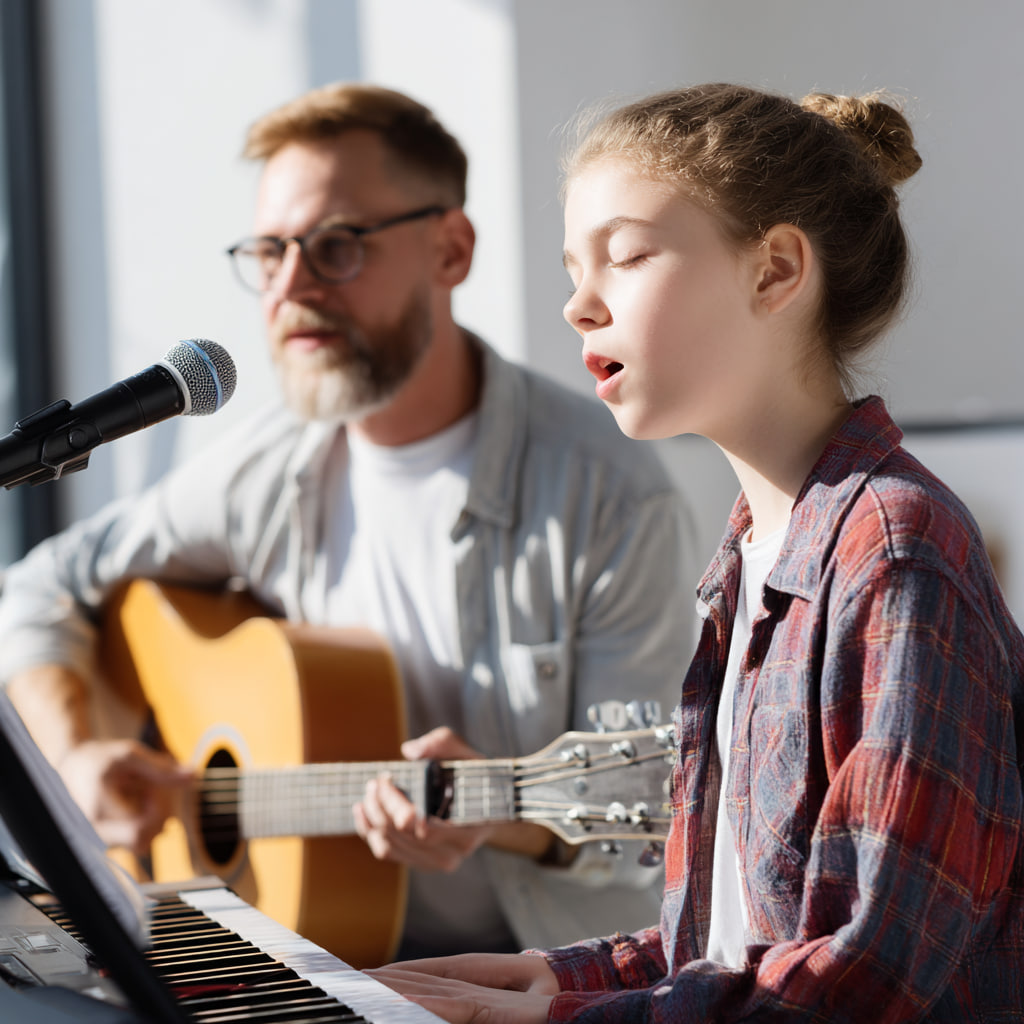
Great composers are first great listeners. Before pen touches paper or fingers strike keys:
Mia’s journey started when she began listening to Chopin nocturnes every night. Slowly, she understood the shape of music—not just the sound.
To compose freely, you need tools to express ideas:
✓ Scales and Keys: Understand major and minor tones.
✓ Harmony and Chords: How notes combine to create mood.
✓ Rhythm: Time signatures and rhythmic patterns.
✓ Form: Song structures (verse-chorus) or classical forms (binary, sonata).
Don’t let “theory” scare you—it’s simply a language. Mia spent a few weeks learning chord progressions on piano, which unlocked the ability to build emotional soundscapes.
Begin with tiny melodies or rhythms:
✓ Hum a tune and try to play it on an instrument.
✓ Write a 4-bar melody with 2 chords.
✓ Loop a rhythmic pattern and build from there.
Every great composer started small. Beethoven’s “Ode to Joy” begins with just a handful of notes.
Mia’s first composition was a 20-second tune called “Raindrops on Glass”. It wasn’t perfect, but it was hers.
While music allows freedom, there are guiding principles that help beginners:
✓Voice Leading: Smooth movement between chords.
✓ Balance and Contrast: Mix repetition with surprise.
✓ Tension and Release: Use dynamics and harmony to tell a story.
✓ Motivic Development: Take a small idea and transform it (variation, inversion).
✓ Instrumentation: Learn how different instruments color sound.
These rules aren’t prison walls—they’re stepping stones. Mozart once said, “The music is not in the notes, but in the silence between.”
Don’t fear imitation. Study your favorite composers:
✓Transcribe parts of their music.
✓Change the key or rhythm to make it your own.
✓ Blend influences—jazz chords with classical strings, or folk melodies with modern beats.
Mia fell in love with Joe Hisaishi’s film scores and began writing waltzes with whimsical harmonies inspired by him. Over time, her own voice emerged.
Every composer faces:
✓ Writer’s Block: Silence is normal. Sometimes the best idea comes after a break.
✓ Criticism: Even Mozart was told his music had “too many notes.”
✓ Technical Limitations: You don’t need to be a virtuoso to write beautiful music.
What matters is persistence. Composition is like learning a language—you speak awkwardly at first, then fluently, then poetically.
Enroll in a music school or composition class where:
✓Teachers guide you step-by-step.
✓You collaborate with other musicians.
✓ You hear your music performed, which is the fastest way to learn. Mia joined a weekly composition workshop. Hearing classmates play her ideas helped her understand what worked and what didn’t—something no book could teach.
Today’s beginner composers can experiment with:
✓ Notation Software: MuseScore, Finale, Sibelius.
✓ Digital Audio Workstations (DAWs): GarageBand, FL Studio, Logic Pro.
✓ Virtual Instruments: Hear full orchestras on a laptop.
These tools let you experiment without needing a symphony at hand.
Learning to compose music isn’t about perfection—it’s about discovery. When you play something that feels alive, you’ve begun composing. Mia, once nervous to even try, now has a folder of ten short pieces. Some are clumsy, some promising, but each one is a victory. With curiosity, guidance from skilled teachers, and patience, anyone can transform feelings into melodies. At [Your Music School Name], we believe every student has a composer hidden inside. All it takes is the courage to play your first note and let the music lead you forward.