Genius in Small Shoes: The Youngest Composers in History and Today
It’s easy to picture a composer as a solemn adult hunched over a grand piano or a cluttered desk full of staves and manuscript paper. But throughout history—and even more so today—some of the world’s most remarkable musical minds have worn tiny shoes and carried lunchboxes to their lessons.
From prodigies of the classical era to TikTok-savvy creators writing scores before they’ve finished primary school, young composers continue to remind us of one beautiful truth: music isn’t limited by age—it’s powered by imagination.
Perhaps the most famous child composer of all time, Wolfgang Amadeus Mozart, began composing at the age of 5. By the time he was 8, he had already written his first symphony. Mozart’s father, Leopold, recognized his genius early and helped him travel across Europe to perform for royalty. What’s astounding is not just Mozart’s technical skill at a young age, but his emotional depth—even as a child, his music moved listeners.
Mozart wasn’t the only young genius. Franz Schubert wrote his first compositions as a child and had completed several string quartets and a symphony by the time he was a teenager. Felix Mendelssohn composed a full-scale opera at just 12, and his Octet for Strings, written at 16, is still considered a masterpiece of chamber music. But these weren’t just one-in-a-million talents locked in history books. Young composers continue to emerge today, shaped by their times, tools, and the same inner fire.
In recent years, children as young as 6 or 7 have been featured in international headlines for composing orchestral works, film music, and even operas.
Take Alma Deutscher, an English composer, violinist, and pianist, who wrote her first piano sonata at 6, and completed her first full-length opera, Cinderella, at just 10 years old. Her music, influenced by Mozart and Romantic composers, has been performed around the world, including at Carnegie Hall and the Vienna State Opera. Alma composes by ear and often dreams up melodies while playing or walking—proof that a child’s mind can be as structurally brilliant as it is playful.
Another inspiring story is that of Jay Jay Boske, a Dutch boy who started composing orchestral music at 7, using computer software and virtual instruments to bring his ideas to life. Like many young composers today, Jay Jay didn’t come from a traditional conservatory background. Instead, he found his voice through technology, video tutorials, and a deep emotional connection to sound.
There is no single formula. Some children begin by improvising on an instrument they love. Others start with melody, singing into recording apps. Some learn notation and immediately want to try writing down their own pieces. What matters most is exposure—to instruments, to musical ideas, to encouragement. Children compose because they are curious, unafraid to try, and deeply connected to feelings they don’t always yet have words for. Composition becomes a way to make sense of the world. It’s not always about genius—it’s about giving children the chance to create something they can call their own.
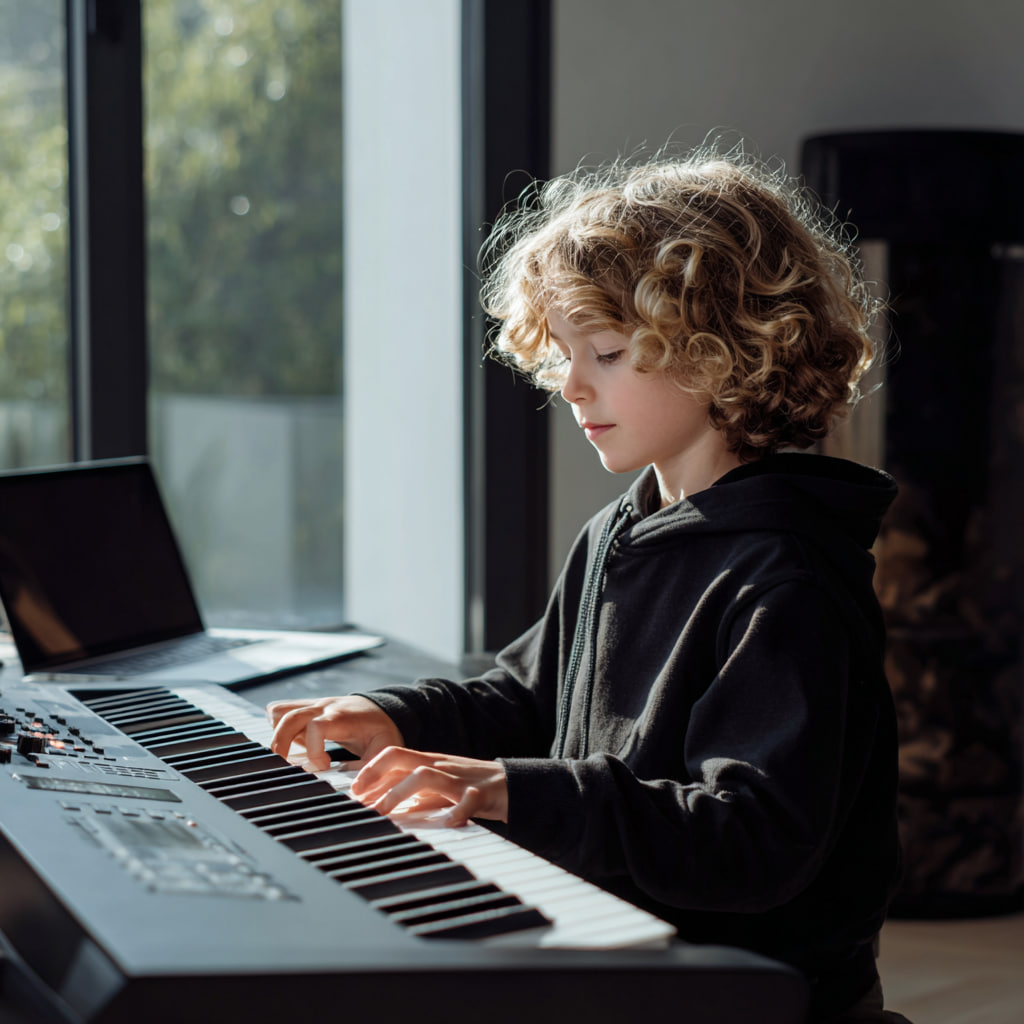
You don’t need a prodigy to nurture a composer. All you need is an open door. If your child hums little tunes or makes up songs at the piano—take notice. Ask them to show you. Record them. Let them hear their own music played back. Give them paper and crayons and let them draw the music. Give them music software or a looper. Most importantly, celebrate ideas, not just results. Teachers play a huge role too. A good teacher sees beyond the scales and finger exercises and invites creativity early on. At our school, we offer both structured composition classes and open exploration time—because both are essential. And we know that even the shyest child might be composing silently in their head, waiting for someone to ask, “What are you hearing?
In an age where music creation is more accessible than ever—through tablets, notation apps, and digital audio workstations—children today are entering the world of composition with powerful tools and endless genres to explore. The classical prodigy, the indie songwriter, the video game score designer, the film music enthusiast—all of these may grow from the same spark. And while not every child who composes young will grow up to become Mozart or Alma Deutscher, what they willbecome is a person who knows how to listen, to imagine, and to create. And that is something worth composing for.