If the violin were a kingdom, Antonio Stradivari would be its monarch—and his workshop the royal court where beauty, brilliance, and mystery were shaped in wood. Born in Cremona, Italy, sometime around 1644, Stradivari wasn’t just a luthier. He was a master of both form and soul, crafting instruments that would go on to enchant centuries.
But Stradivari did not invent the violin. That credit belongs to earlier Cremonese luthiers like Andrea Amati. What Stradivari did was refine it—polish its voice, sculpt its silhouette, and, in doing so, usher in what is now known as the Golden Age of Violin Making.
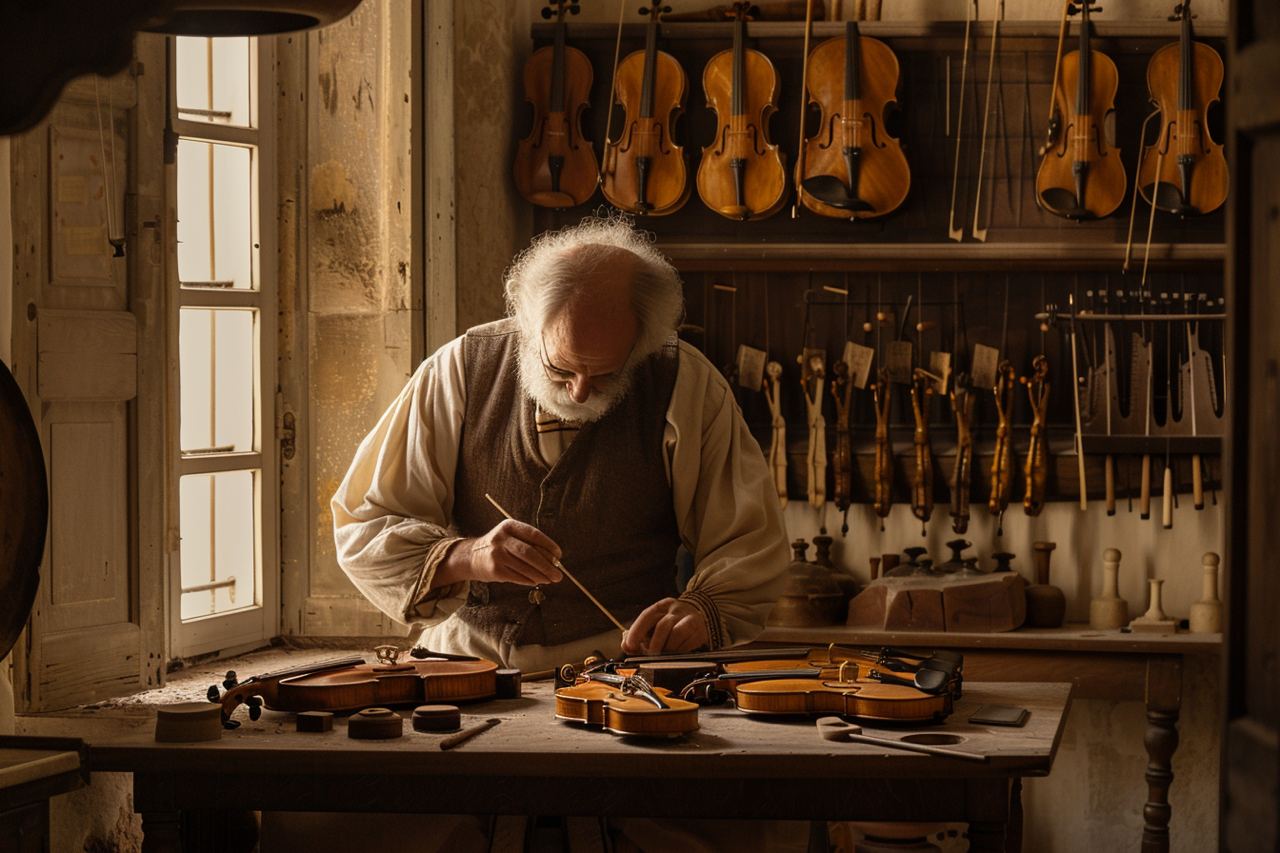
But Stradivari did not invent the violin. That credit belongs to earlier Cremonese luthiers like Andrea Amati. What Stradivari did was refine it—polish its voice, sculpt its silhouette, and, in doing so, usher in what is now known as the Golden Age of Violin Making.
Antonio Stradivari likely apprenticed with Niccolò Amati, grandson of Andrea Amati, although no formal records survive. But whether formally or not, Stradivari absorbed the Cremonese tradition and soon surpassed it.
By the 1680s, his instruments were already renowned across Europe for their resonance, power, and sheer elegance. They were not only visually stunning—with precise curves and rich varnishes—but they also sang like nothing anyone had ever heard.
Over his lifetime, Stradivari built more than 1,100 instruments—mostly violins, but also violas, cellos, and a few guitars and harps. Today, only about 650 survive, and they are among the most prized and expensive musical instruments in the world.
Most experts agree that Stradivari’s finest work came during the first two decades of the 1700s, often referred to as his “Golden Period.” During this time, he perfected the proportions, thickness, and arching of the violin to produce instruments with:
Some of the most famous violins in existence were made in this era, including the legendary “Messiah” Stradivarius(1716), which has remained almost untouched and is preserved in near-perfect condition.
What made his instruments so special?
That question has puzzled scientists, musicians, and historians for centuries. Various theories have been proposed:
Researchers have used X-rays, CT scans, and even chemical analysis to unlock his secrets—but no single factor explains the magic. It’s likely a combination of materials, skill, intuition, and obsessive craftsmanship.
And, of course, the man himself.
Today, owning a Stradivarius is like holding a piece of musical eternity. Legendary violinists like Jascha Heifetz, Itzhak Perlman, and Anne-Sophie Mutter have performed on Strads, some of which are insured for millions of dollars.
But these instruments aren’t just trophies. They are alive—each one with a distinct personality. Violinists often speak of their Stradivarius as if it were a partner, even a soulmate. The sound, the touch, the feel beneath the fingers—it’s intimate, complex, and inspiring.
Antonio Stradivari died in 1737 at the age of 93—an extraordinary lifespan for his time. He left behind not only a treasure of instruments but a lineage of craftsmanship that still shapes how violins are built today.
Modern luthiers study his work obsessively. Museums guard his surviving instruments. And musicians still dream of one day playing on one.
Because to play a Stradivari is not just to perform music. It’s to commune with history. With genius. With the voice of a man who, through nothing but wood and will, made sound eternal.