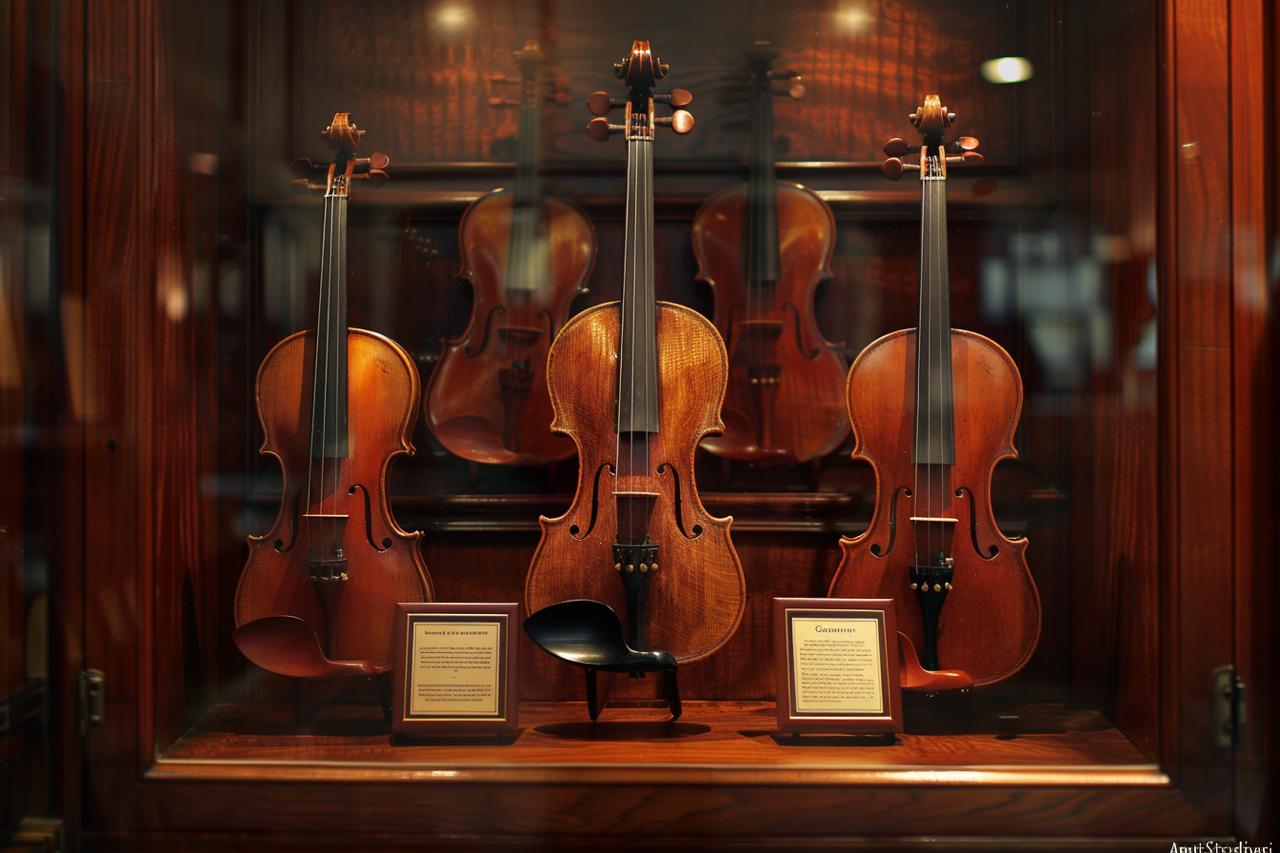
Walk into any concert hall, and you may hear a violin that has outlived kingdoms. You may be listening to an instrument crafted by hands that never saw electricity, yet shaped the very definition of sound. The three most revered names in violin making—Amati, Stradivari, and Guarneri—represent a golden triangle of history, mastery, and mystique.
But how do these violins compare? What sets each one apart in tone, craftsmanship, and legacy?
Let’s step into Cremona, Italy—the birthplace of them all—and explore the differences.
Founder: Andrea Amati
Active: Mid-1500s to early 1600s
Famous Instruments: “Charles IX” violin (1564)
Price Today: Rare Amatis can range from $100,000 to $600,000+
The Amatis were the original violin innovators. Andrea Amati, often called “the father of the violin,” was the first to standardize the shape and design that still defines violins today—arched top and back, four strings, curved bouts.
His grandson Niccolò Amati elevated the family’s reputation even further. Niccolò’s violins were slightly larger and more powerful, yet retained the delicate elegance Amati instruments are known for: soft, sweet tone, and visual refinement. These violins often have a clear, mellow voice—perfect for chamber music.
Legacy: Niccolò Amati was the teacher of both Antonio Stradivari and Andrea Guarneri. In many ways, all great violins lead back to the Amati bench.
Lifespan: ca. 1644–1737
Famous Instruments: “Messiah” (1716), “Soil” (1714), “Lady Blunt” (1721)
Golden Period: 1700–1720
Price Today: $2–16 million+
Stradivari didn’t just make violins—he perfected them. His instruments are revered for their powerful projection, radiant tone, and structural precision. Many describe Stradivaris as having both strength and sweetness, capable of slicing through an orchestra or whispering intimately in a solo.
He experimented throughout his life—changing arching, varnish, and proportions—but during his “Golden Period”, his instruments reached unmatched clarity and richness.
Strads are prized by soloists for their balance and versatility. Many of today’s top violinists (like Itzhak Perlman and Anne-Sophie Mutter) have either played or recorded with Strads.
Fun Fact: The “Messiah” Stradivarius, made in 1716, remains virtually unplayed and is housed in Oxford. It’s the most pristine example of his work.
Lifespan: 1698–1744
Famous Instruments: “Il Cannone” (1743), “Vieuxtemps” (1741), “Ole Bull” (1744)
Price Today: $5–20 million+
If Stradivari was the perfectionist, Guarneri del Gesù was the maverick. His violins broke rules. They were bold, rugged, and powerful—with slightly shorter bodies, thicker bouts, and often less “polished” finishes. But the sound? Unmatched raw energy and darkness.
Guarneris are beloved by fiery performers—Niccolò Paganini famously played one, calling it his “cannon.” Today, musicians like Pinchas Zukerman and Hilary Hahn seek out their primal voice and emotional depth.
Unlike Stradivari’s refined elegance, Guarneri’s instruments feel like they want to fight, dance, and weep—all at once.
Legacy: Guarneri del Gesù made fewer violins (about 150 known today), making each one exceptionally rare and often more expensive than a Strad.
Feature | Amati | Stradivari | Guarneri del Gesù |
|---|---|---|---|
Tone | Sweet, elegant, light | Brilliant, balanced, rich | Dark, bold, intense |
Ideal For | Chamber music | Soloists, orchestras | Virtuoso soloists |
Craftsmanship Style | Refined, delicate | Precise, polished, experimental | Rugged, expressive |
Surviving Instruments | ~100 | ~650 | ~150 |
Price Range | $100k–600k+ | $2–16M | $5–20M+ |
Era | 1500s–1600s | 1660s–1737 | 1720s–1744 |
Feature | Amati |
|---|---|
Tone | Sweet, elegant, light |
Ideal For | Chamber music |
Craftsmanship Style | Refined, delicate |
Surviving Instruments | ~100 |
Price Range | $100k–600k+ |
Era | 1500s–1600s |
Stradivari | Guarneri del Gesù |
|---|---|
Brilliant, balanced, rich | Dark, bold, intense |
Soloists, orchestras | Virtuoso soloists |
Precise, polished, experimental | Rugged, expressive |
~650 | ~150 |
$2–16M | $5–20M+ |
1660s–1737 | 1720s–1744 |
Every time a student picks up a violin, they are holding a piece of this legacy. Whether learning basic bowing or performing a concerto, the shape, structure, and soul of the instrument trace directly back to Cremona, to these three families, and to their obsession with perfection and sound.
Studying music isn’t just about learning notes. It’s about understanding where they came from—and the extraordinary hands that shaped the tools to bring them to life.